

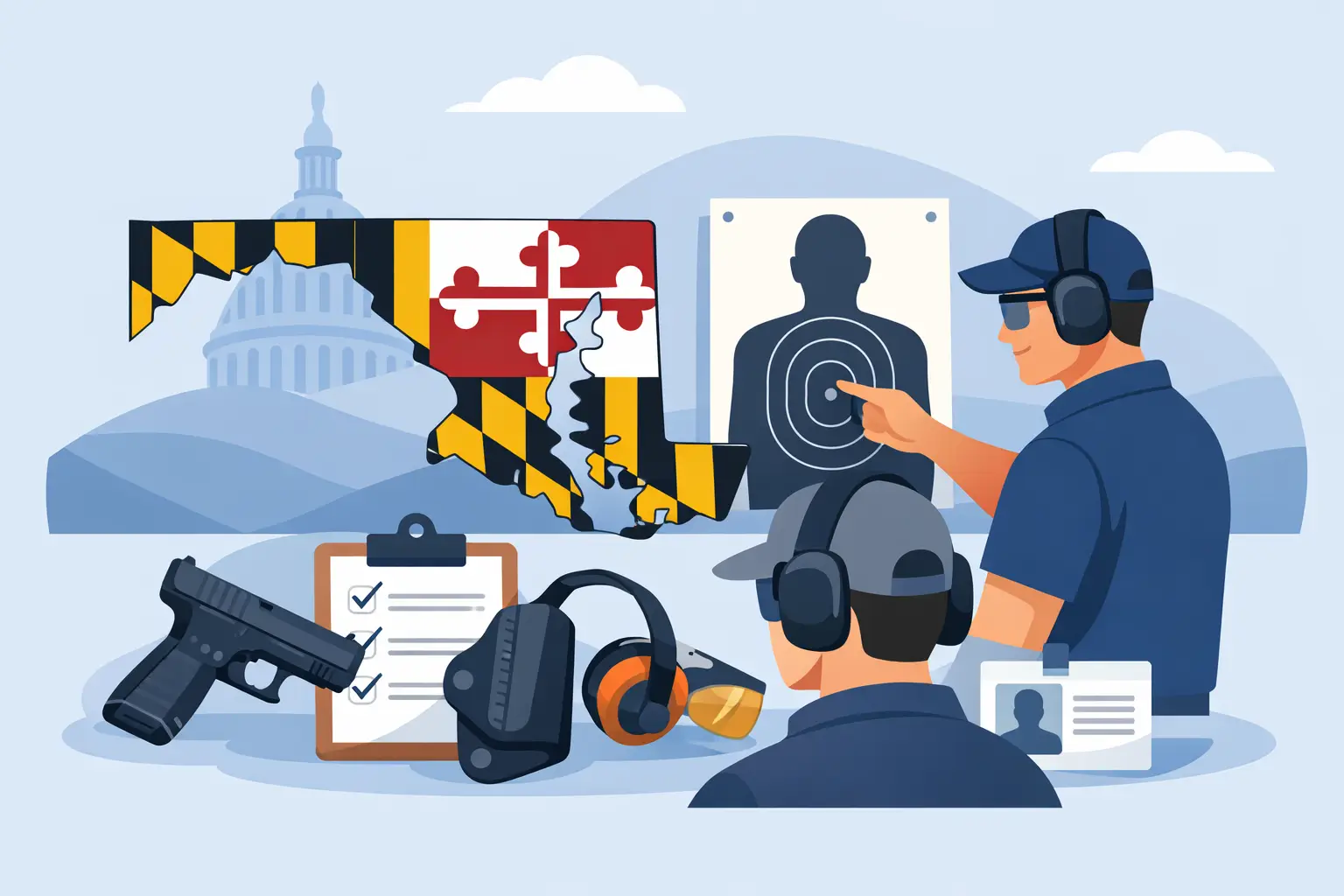
A Maryland Wear and Carry permit is not a casual credential. It carries a serious legal responsibility, requires disciplined decision-making, and depends on an application package that is complete, accurate, and supported by qualifying training. For responsible civilians and security professionals in the Maryland, DC, and Virginia region, the right preparation starts before arriving at the range.
Maryland Wear and Carry training should build more than a passing score. It should prepare you to handle a firearm safely, understand where carry is restricted, make lawful decisions under pressure, and document your training for the Maryland State Police application process. A course certificate is valuable only when it reflects legitimate instruction, appropriate qualification, and a student who is prepared to carry responsibly.
What Maryland Wear and Carry Training Covers
The Maryland Wear and Carry permit training pathway is designed to establish a foundation in firearm safety, state law, and practical handgun handling. Initial applicants generally must complete the required instructional hours and demonstrate proficiency through a live-fire qualification. Renewal applicants are typically subject to a shorter training requirement, but they should not treat renewal as a paperwork exercise. Skills, legal knowledge, and equipment habits must remain current.
A professionally structured course addresses safe loading and unloading, storage, cleaning, malfunction awareness, shooting fundamentals, and responsible carry practices. It also addresses the legal side of armed responsibility: when force may be justified, the duty to avoid reckless conduct, interactions with law enforcement, prohibited locations, and the consequences of carrying while impaired or emotionally compromised.
Students should expect classroom instruction and range work. The classroom establishes the rules and decision-making framework. The range confirms that the applicant can safely operate and control the handgun used for qualification. Neither part replaces the other.
The Qualification Is Not the Entire Standard
A firing qualification measures a defined set of skills under controlled conditions. It does not prove that a person will make correct decisions in a fast-moving confrontation. That distinction matters.
Responsible instruction treats qualification as a baseline. Students should learn safe muzzle management, trigger-finger discipline, target identification, proper holster practices, and the importance of avoiding unnecessary firearm handling in public. A permit holder must understand that carrying a handgun increases the need for restraint, awareness, and sound judgment.
Know the Difference Between a Permit and a Security Credential
Many students in the region work, or intend to work, in private security. A Maryland Wear and Carry permit may be relevant to lawful concealed carry, but it is not automatically the same as an armed security authorization, employer credential, or jurisdiction-specific registration.
Private-security work often involves separate requirements for employment, firearms authorization, uniforms, assignments, supervision, reporting, and employer policies. A security officer who works across Maryland, Washington, DC, and Virginia may face different rules in each jurisdiction. Do not assume that a credential issued in one location grants authority to work armed in another.
Before registering for training, identify your purpose. Are you applying as a civilian permit applicant? Renewing an existing Maryland permit? Preparing for an armed private-security role? Seeking a separate District of Columbia or Virginia credential? The correct course depends on the authority you need, not simply on the firearm you own.
Prepare Before You Register
Training goes more smoothly when students arrive with their documentation, equipment, and expectations in order. The application process can involve background review, fingerprinting, identity verification, training records, and other Maryland State Police requirements. Requirements and procedures can change, so applicants should verify the current state process before submitting materials.
If you are taking an initial course, confirm that the curriculum and instructor credentials meet Maryland requirements for your application type. Retain your training certificate and qualification documentation in a secure location. Review every name, date, and identification number before filing. Small errors can create delays that are avoidable with careful preparation.
For the range portion, use reliable equipment that you can safely operate. A suitable handgun, appropriate ammunition, eye protection, hearing protection, and a secure holster or case may be required depending on the course format. Do not arrive with unfamiliar equipment and expect the qualification day to serve as your first practice session. If you are new to handguns, foundational instruction before the permit course is often the better choice.
Equipment Choice Has Practical Consequences
The smallest handgun is not always the easiest handgun to qualify with or carry safely. Compact firearms may be convenient to conceal, but they can produce more felt recoil, offer a shorter sight radius, and be harder for some shooters to control. A larger handgun may be easier to shoot accurately but less comfortable for daily carry.
Holster selection deserves the same attention. A holster must secure the firearm, protect the trigger guard, retain its shape, and support safe reholstering. Carry methods that require placing a loose handgun in a pocket, purse, waistband, or vehicle compartment create unnecessary risk. The right setup depends on clothing, body type, daily activity, and the user’s ability to draw and reholster without violating basic safety rules.
What Good Instruction Looks Like
A professional Maryland Wear and Carry training course should be organized, safety-driven, and direct about the limits of a permit. Look for instructors who can explain the course standard, conduct a controlled range qualification, correct unsafe behavior immediately, and provide clear documentation after successful completion.
Quality instruction is not measured by how quickly a class can issue a certificate. It is measured by whether students leave with a defensible understanding of firearm safety, legal constraints, and personal responsibility. The instructor should be willing to tell a student when additional practice is needed. That is not a barrier to success. It is proper risk management.
Reality-based training also has a place in the learning process. A permit holder should think through ordinary situations: entering a restricted location, securing a firearm before travel, responding to a confrontation without displaying a weapon unnecessarily, and communicating clearly with responding officers. These decisions are usually more relevant to safe carry than speed alone.
Legal Carry Requires Ongoing Attention
Receiving a permit does not eliminate the need to monitor the law. Carry restrictions, application procedures, court decisions, and agency guidance may change. Permit holders must remain aware of prohibited places, transportation requirements, renewals, and any conditions that affect their eligibility.
A firearm should never become a substitute for awareness, verbal de-escalation, or a safe exit. In many situations, the best defensive decision is to create distance, call law enforcement, and avoid escalating a conflict. Carrying a handgun is a responsibility to be exercised with restraint, not a license to intervene in every dispute.
This principle is especially relevant for security professionals. An officer’s authority is defined by the assignment, employer policy, training, state registration, and applicable law. Acting outside that authority can place the officer, employer, client, and public at risk. Professional credibility depends on knowing where your role begins and ends.
Build a Training Plan That Matches Your Goal
Students who want a Maryland permit should plan beyond the initial class. Continue practicing the fundamentals that matter: safe presentation from an approved holster, controlled accuracy, reload and malfunction procedures where appropriate, judgment under stress, and safe storage at home and in vehicles. Practice must be deliberate. Repeating unsafe habits only makes them harder to correct.
For those building a private-security career, combine permit-related training with the credentials required for the jobs you seek. Armed assignments may call for additional firearms qualifications, state registration, defensive-equipment training, report-writing skills, active-shooter response, or professional communication training. The strongest candidates are not defined by one certificate. They demonstrate consistent compliance, sound judgment, and dependable operational habits.
A Security Training Academy, Inc. approaches firearms and protective-services education with that professional standard in mind: train to meet the requirement, then continue training to meet the responsibility. Before you submit an application or step onto the range, make sure your course, equipment, documents, and career goal all point in the same direction.
 Install Security Training Academy