

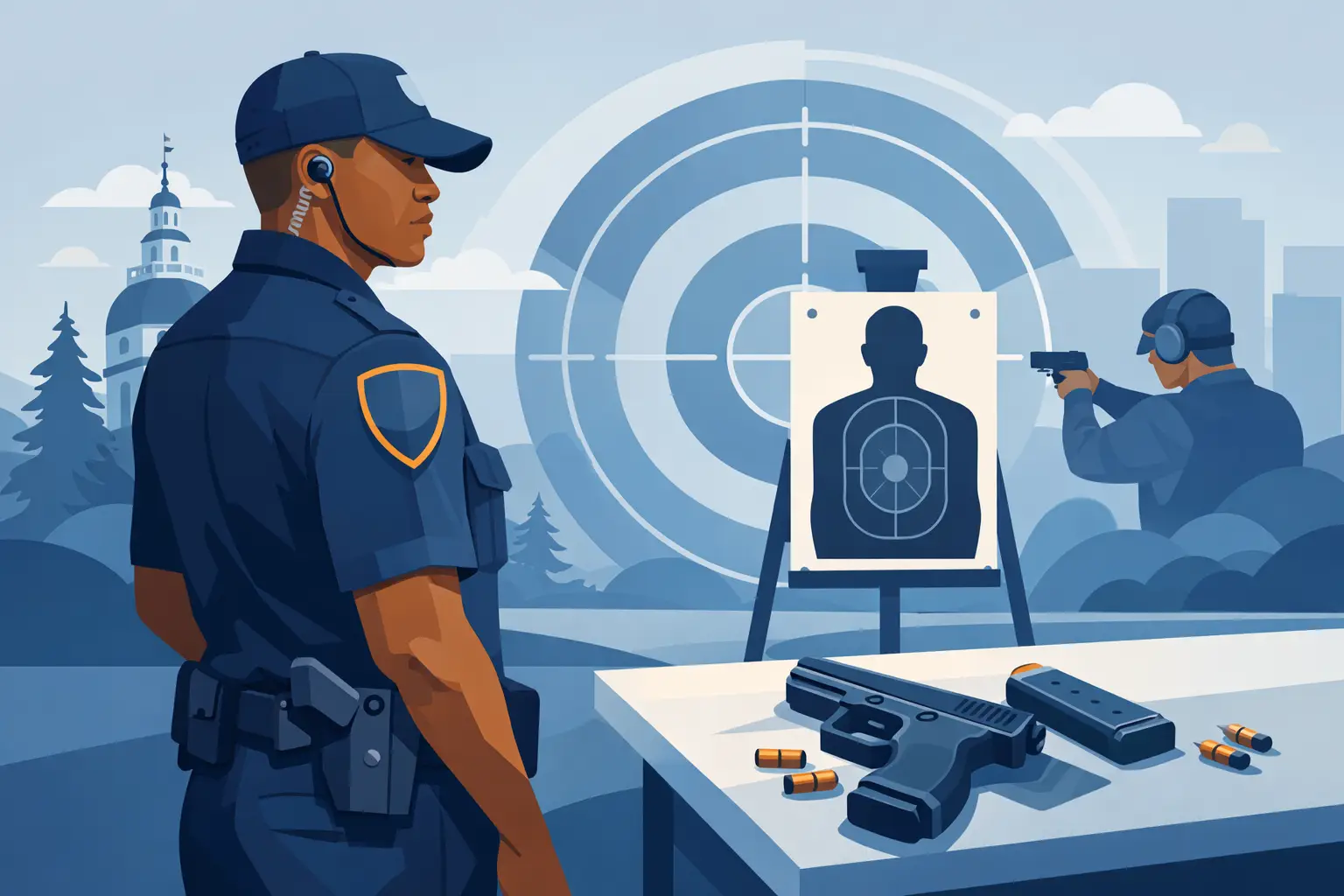
A Maryland armed security handgun qualification is not a casual trip to the range. It is part of the professional process for security officers whose assignments may require them to carry a handgun while working. Your qualification record, training documentation, employer expectations, and licensing status must all support one another. A good score matters, but it is only one part of becoming eligible and prepared for armed work.
For applicants entering private security, the process can feel complicated because Maryland firearms requirements are separate from Virginia DCJS credentials, District of Columbia Special Police requirements, and civilian concealed-carry training. Do not assume that a permit, prior military service, law-enforcement experience, or qualification completed in another jurisdiction automatically satisfies Maryland armed-security requirements. Confirm the current Maryland pathway before you register, pay fees, or report for range training.
What the Qualification Is Designed to Prove
An armed security officer has a greater level of responsibility than an unarmed officer. The handgun qualification is intended to document that the officer can safely handle, load, unload, fire, and control a handgun under an approved course of instruction. It also gives the instructor an opportunity to identify unsafe habits before a student is placed in a position where mistakes can carry legal, professional, and personal consequences.
The range portion is not simply about shooting quickly or producing a tight group at one distance. A properly conducted course evaluates safe muzzle discipline, trigger-finger control, loading procedures, shooting fundamentals, decision-making under instruction, and the ability to follow a prescribed course of fire. Depending on the approved training program and the student’s status, training may also address legal use of force, weapon retention, safe storage and transport, reportable incidents, and the limits of a security officer’s authority.
A qualification score demonstrates a minimum performance standard on that course of fire. It does not mean an officer is ready to work every post. A quiet residential assignment, an armored-car detail, a retail loss-prevention assignment, and executive protection each create different risks. Employers may require additional site training, company policy instruction, equipment familiarization, or a higher internal performance standard.
Start With the Correct Maryland Credential Path
Before scheduling handgun training, determine exactly why you need it. An applicant seeking armed private-security employment must understand the Maryland security-guard registration process and any firearm-related certification or approval required for the duties they will perform. A Maryland Wear and Carry Permit serves a different purpose from employment authorization as an armed security officer. One credential should never be treated as an automatic substitute for the other.
Your prospective employer is a practical starting point. Ask whether the company is hiring for armed posts, whether it will sponsor or guide your application process, what weapon platform it authorizes, and whether it has post-specific qualification requirements. An employer may limit officers to particular handgun types, calibers, holster systems, ammunition, or carry conditions. Training with one setup and arriving at work with another can create delays and unnecessary expense.
Students should also verify whether they must first complete security-guard registration steps, provide fingerprints, submit identification documents, complete background-review requirements, or obtain other approvals before working an armed post. Government forms, fees, processing periods, and application procedures can change. Use current instructions from the appropriate Maryland authority and keep copies of every submission.
Do Not Mix Jurisdictions
The Maryland-Washington-DC-Virginia region creates opportunities for security professionals, but it also creates compliance problems for officers who assume credentials travel with them. Virginia DCJS firearms endorsement training is not the same as Maryland armed-security qualification. DC concealed-carry or Special Police training is not the same as Maryland training. Likewise, civilian permit instruction may build valuable skills, but it may not meet employment-specific requirements.
If your career plan includes work across state lines, organize your records by jurisdiction. Keep separate folders for training certificates, qualification scores, registration numbers, renewal dates, fingerprint confirmations, applications, and employer-issued credentials. This simple discipline prevents missed deadlines and helps you respond quickly when a company requests proof of eligibility.
How to Prepare Before Range Day
Show up ready to learn, not ready to prove that you already know everything. Even experienced shooters benefit from a structured review of safe gun handling and the specific commands used on a qualification course. The instructor controls the firing line. Students who listen carefully, ask direct questions, and follow commands exactly are safer and usually perform better.
Confirm the course requirements before arrival. Ask what government-issued identification, prior credentials, registration documentation, eye and ear protection, ammunition, handgun, magazines, holster, belt, and other equipment are required. Do not bring equipment that has not been approved for the course or your intended employer. If a rental or academy-provided handgun is available, confirm that arrangement in advance rather than assuming one will be waiting.
Your handgun should be clean, functional, and appropriate for the training. Test magazines for reliability before class. Bring the required quantity and type of ammunition, but do not make ammunition changes at the last minute if you have not tested the firearm with it. A malfunctioning magazine, loose sight, poorly fitted holster, or unfamiliar handgun can turn a manageable qualification into a preventable problem.
Physical preparation matters as well. Hydrate, eat before you arrive, dress for outdoor range conditions, and wear closed-toe shoes. Cold, heat, rain, fatigue, and stress affect grip, vision, concentration, and patience. These conditions can also affect an armed officer during a real assignment, which is why disciplined range habits matter.
What Instructors Look for on the Firing Line
Accuracy is visible on the target. Safety and judgment are visible in every movement before and after each string of fire. Students are expected to maintain muzzle awareness, keep their finger off the trigger until they are prepared to fire, follow loading and unloading commands, and immediately report a problem. Trying to fix a malfunction without direction can create a safety issue, particularly for a student who is rushed or frustrated.
The strongest students do not chase speed at the expense of control. They establish a stable stance, use a consistent grip, maintain sight alignment, manage the trigger smoothly, and recover their sights after recoil. If rounds are landing off target, do not guess at the solution. Ask the instructor for coaching. A correction to grip pressure, trigger movement, visual focus, or body position can make a meaningful difference.
Qualification courses may require shooting from several distances or positions and may include timed stages. The correct response to time pressure is not panic. Load properly, listen for the command, perform the task safely, and maintain your fundamentals. A missed shot can be corrected through practice. A serious safety violation can end training immediately.
If You Do Not Qualify the First Time
A first-time failure should be treated as a training issue, not a reason to hide the result or seek shortcuts. Review the target with the instructor. Determine whether the problem was fundamentals, unfamiliar equipment, difficulty with a timed stage, poor ammunition or magazine performance, or a failure to understand the course commands.
Then practice with a purpose. Randomly firing boxes of ammunition may build confidence, but it does not always correct the reason for missed shots. Focus on the exact skill that caused the problem. Dry-fire practice, when conducted safely with a confirmed unloaded firearm and no live ammunition in the practice area, can help improve grip, sight presentation, trigger control, and reload movements. Live-fire coaching should follow so that the correction is confirmed on the range.
Do not attempt to alter, misrepresent, or reuse paperwork outside its authorized purpose. Qualification documentation is a professional record. Accuracy protects the student, the instructor, the employer, and the public.
Keep Your Training Record Ready for Review
After successful completion, keep the original training and qualification documents in a secure place and retain digital copies as backup. Review the documents before leaving the training location. Confirm that your name, training date, instructor information, course designation, and any required scores or signatures are correct. Administrative errors are easier to correct immediately than weeks later when you are applying for work or renewing a credential.
Set calendar reminders well before expiration or renewal deadlines. Armed security credentials can involve more than one renewal cycle: an employer credential, a security registration, a firearms qualification, a permit, or other jurisdiction-specific documentation. Missing one deadline can affect your ability to remain assigned to an armed post, even if other paperwork is current.
A Security Training Academy, Inc. trains students to approach firearms qualifications as part of a larger professional standard: safe handling, lawful decision-making, accurate documentation, and readiness for the assignment. That standard is what employers notice after the range score is recorded.
Your goal is not merely to pass a course of fire. Build the habits that make you dependable when a supervisor checks your credentials, when an instructor gives a safety command, and when the public expects an armed officer to act with restraint and control.
 Install Security Training Academy