

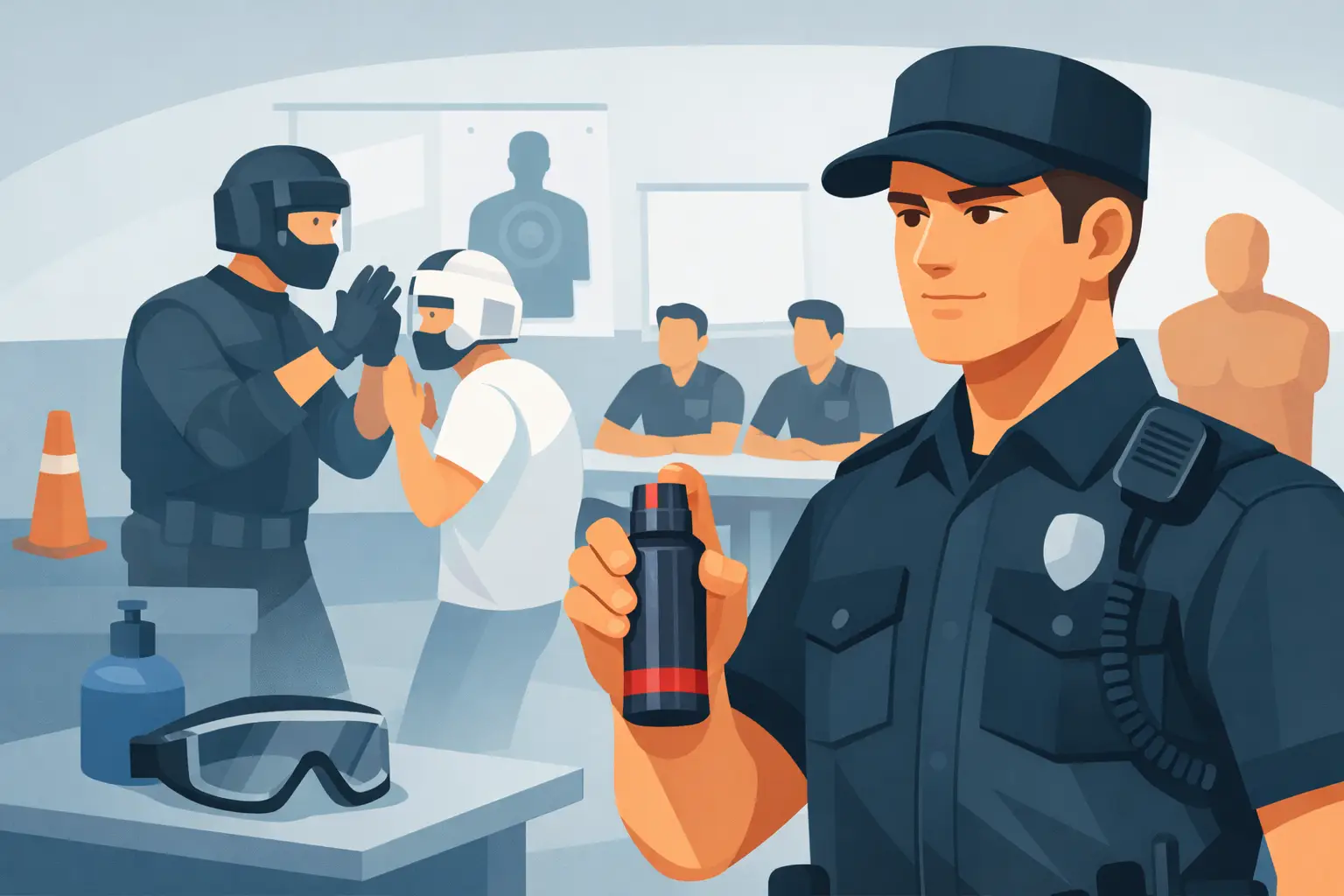
A canister of OC spray is not a substitute for judgment. For a security officer, it is a force option with legal, medical, tactical, and employment consequences. OC spray certification training prepares officers to make defensible decisions under pressure, deploy the tool correctly when authorized, and explain exactly what occurred afterward.
For professionals working in Virginia, Washington, DC, and Maryland, the question is not simply whether you can carry OC spray. The question is whether your employer, assignment, licensing status, post orders, and applicable rules authorize it – and whether you have current training that supports your use of force decision. A poorly handled deployment can turn a manageable incident into an injury, complaint, civil claim, or loss of employment.
What OC Spray Certification Training Should Accomplish
Effective OC spray training is practical, controlled, and built around the duties of private security personnel. It should not treat pepper spray as a consumer product or a simple self-defense accessory. Security officers work around clients, patrons, staff, bystanders, cameras, confined spaces, and emergency responders. They must account for all of them before deciding to deploy.
A professional course addresses the chemical agent itself, including how oleoresin capsicum affects the eyes, respiratory system, skin, and behavior. Officers learn the differences among spray patterns, canister designs, effective distances, environmental limitations, and common equipment failures. They should understand that OC spray may cause temporary impairment but does not guarantee compliance. Some subjects continue resisting, become more agitated, or move unpredictably after exposure.
The core of certification is decision-making. Officers need to recognize when verbal direction, time, distance, cover, disengagement, or calling law enforcement is the safer response. They also need to recognize when a subject’s actions create an immediate safety problem that cannot be reasonably controlled by lower-level options.
Training should make a clear distinction between a person who is verbally difficult and a person who presents active physical resistance or an imminent threat. Anger, profanity, refusal to leave, or noncompliance alone do not automatically justify an OC deployment. The officer’s authority, the facts observed, employer policy, and the applicable use-of-force standard all matter.
OC Spray Certification Training Is Not a Carry Permit
Completion documentation matters, but a certificate does not independently grant authority to carry or use OC spray on every assignment. An officer may still need employer approval, assignment-specific authorization, required registration, or additional training under company policy. Armed and unarmed personnel may also operate under different procedures depending on the jurisdiction and role.
Before registering, confirm what your employer or prospective employer requires. Ask whether the course is accepted for the position, whether a particular product is issued, whether practical exposure is required, and how often refresher training is expected. Keep copies of your training certificate, course completion record, and any policy acknowledgment in your personnel file.
A Security Training Academy, Inc. approaches defensive-equipment instruction as part of a professional security career path, not as a stand-alone shortcut. The officer who understands post orders, report writing, defensive tactics, and de-escalation is better prepared to use OC spray responsibly than the person who only knows how to press an actuator.
The Skills That Matter on Duty
A legitimate course should require more than classroom attendance. Officers need hands-on practice with inert training units or approved practical exercises so they can safely draw, orient, activate, and secure the canister. Under stress, common errors include holding the canister upside down, spraying from too far away, stepping into the aerosol cloud, losing track of bystanders, or failing to transition after the initial burst.
Good practical training develops several connected skills:
- Carrying and accessing the device from the approved location without exposing it unnecessarily.
- Giving clear commands and creating distance before, during, and after deployment.
- Using appropriate target areas and controlled bursts consistent with training and policy.
- Moving off the line of contamination, avoiding cross-contamination, and monitoring the subject.
- Transitioning to handcuffing, control techniques, disengagement, medical response, or law-enforcement notification as the incident requires.
The transition is often the difference between a controlled response and a failed one. OC spray can create a brief tactical advantage, but it may also create confusion. The officer must be prepared for a subject who closes distance, resists restraint, falls, complains of distress, or attempts to flee.
Scenario-based instruction is especially valuable because it forces officers to identify the problem before selecting the tool. A disorderly trespasser in a crowded lobby, an intoxicated person near an exit, and an assaultive subject in a parking structure may all require different responses. There is no responsible one-size-fits-all answer.
Decontamination and Medical Awareness Are Part of the Job
After OC spray is deployed, the officer’s responsibility continues. The subject must be monitored, and the scene must be managed. Fresh air, calm instructions, avoiding further contamination, and access to appropriate medical assistance may be necessary depending on the person’s condition and agency policy.
Officers should never make medical assumptions based only on the fact that the agent is commonly described as nonlethal. Respiratory distress, asthma complaints, head injury from a fall, excited behavior, intoxication, restraint concerns, and other medical issues require prompt attention. If emergency medical services are needed, request them without delay and communicate what agent was used, when it was used, and what symptoms were observed.
Decontamination procedures also protect everyone else on scene. Contaminated hands, gloves, clothing, patrol vehicles, holding areas, and restraint equipment can transfer OC to staff, police officers, medical personnel, and uninvolved civilians. Training should cover safe handling, cleanup procedures, and the limits of water or other commonly suggested remedies. Do not improvise with oils, creams, or unapproved products that can worsen contamination or complicate medical care.
Documentation Must Match the Force Decision
An OC spray report should allow a supervisor, client, investigator, or court to understand why the officer acted. Vague language such as “the subject was aggressive” is not enough. Document the specific behavior you observed, the commands you gave, the opportunities the subject had to comply, the distance involved, the number and duration of bursts, the area targeted, and what happened after deployment.
Your report should also identify the product used, the canister if required by policy, witnesses, video coverage, law-enforcement notification, medical response, decontamination steps, and the subject’s condition. Write the report promptly while details are fresh. Preserve body-camera footage, surveillance information, photographs, and the used canister when policy requires it.
Professional documentation is not paperwork after the real work. It is part of the real work. If you cannot clearly explain why force was necessary, proportionate, and consistent with training, your decision may be difficult to defend later.
Choosing the Right Course and Preparing to Attend
Select training that is designed for the role you perform, not a generic civilian overview. Review the course description for practical exercises, instructor qualifications, safety procedures, equipment requirements, and proof of completion. If your agency has a written use-of-force policy, bring it to training or review it beforehand so you can identify any differences between broad principles and your employer’s specific rules.
Students should arrive prepared to participate professionally. Wear clothing appropriate for controlled practical activity, follow instructor safety directions, disclose relevant medical concerns where required, and bring identification or registration information requested by the training provider. Do not bring personal defensive equipment unless the course instructions authorize it.
Refresher training is also worth planning before it becomes urgent. Policies change, equipment changes, and skills degrade when they are not practiced. An officer who completed a course years ago but has never reviewed deployment, aftercare, or reporting procedures may not be ready for a fast-moving incident.
OC spray is a serious tool for a serious profession. Train to use it only when justified, know what to do when it does not immediately work, and document every step as if your career depends on it. In private security, that level of discipline is not optional – it is the standard that protects the public, your client, and your authority to serve.
 Install Security Training Academy