

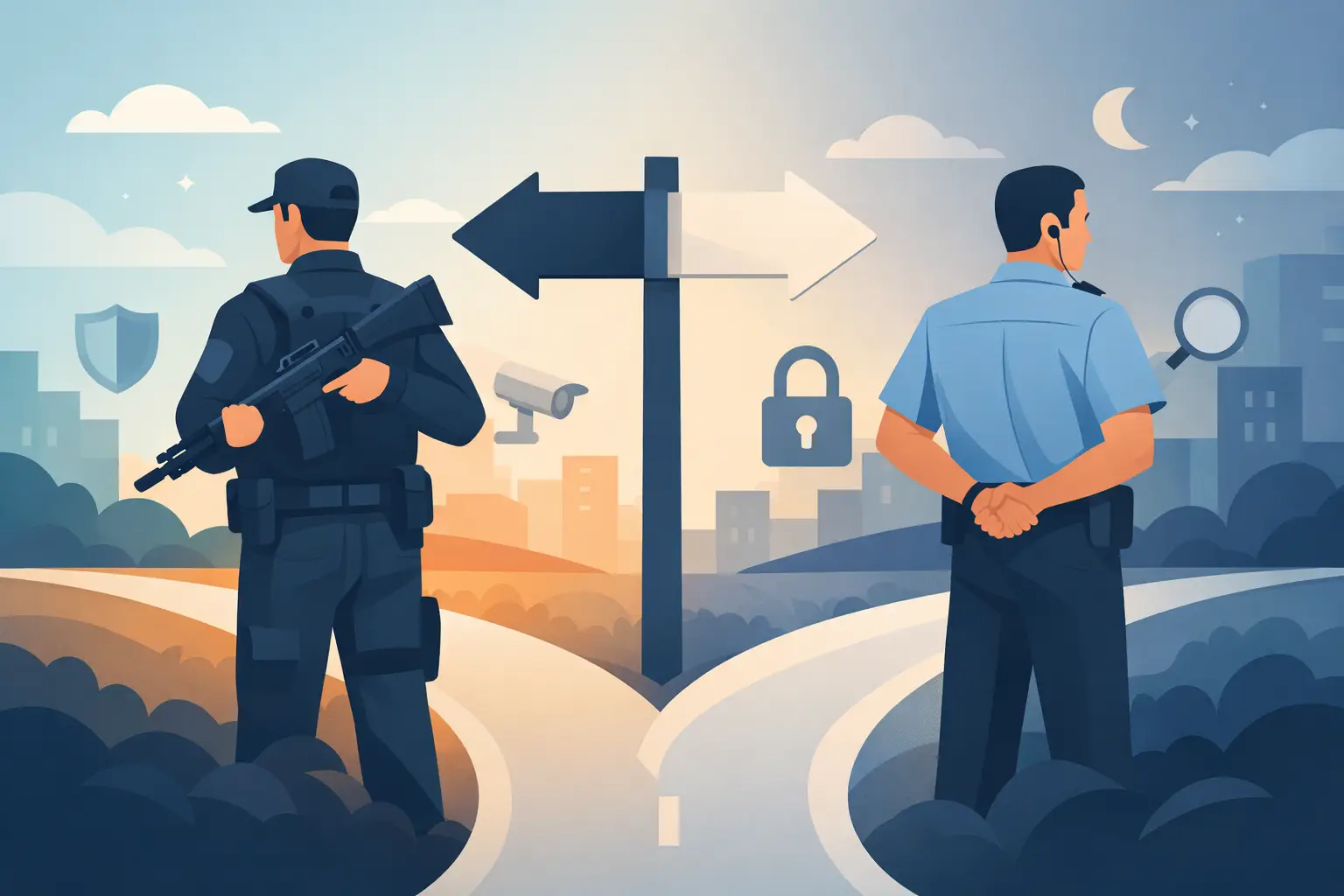
A retail center needs a visible officer who can de-escalate disputes, write clear reports, and protect customers without disrupting business. An executive protection detail may need a professional who can make rapid decisions around a principal and lawfully carry a firearm. That difference is the starting point for armed versus unarmed security work. Neither role is automatically better. Each carries a different level of responsibility, training, legal exposure, and career fit.
For professionals in Virginia, Washington, DC, and Maryland, the right choice begins with the assignment, not the equipment. Employers hire security personnel to manage specific risks. Your registration, training record, jurisdictional authority, and ability to perform under pressure must match that assignment.
Armed Versus Unarmed Security: The Core Difference
Unarmed security officers protect people, property, and operations through presence, observation, access control, communication, reporting, patrols, and early intervention. Their work is often preventive. A capable unarmed officer recognizes problems before they become physical incidents, calls for support promptly, and stays within policy while preserving evidence and documenting what occurred.
Armed security officers perform many of those same duties, but they work with the additional responsibility of carrying a firearm in connection with their licensed private-security role. A firearm does not replace judgment, verbal skills, or situational awareness. It raises the standard for all of them.
The practical difference is not simply whether an officer wears a weapon. Armed work requires a higher level of decision-making because every encounter must be evaluated for legal authority, necessity, proportionality, safety, and aftermath. An armed officer may be assigned to higher-risk posts, but carrying a firearm does not create police powers or eliminate the need to follow employer policy, state rules, and site procedures.
Unarmed Security Is a Professional Career Track
Unarmed positions are often the most direct entry point into private security. Typical assignments include commercial buildings, residential communities, construction sites, hospitals, schools, retail locations, special events, warehouses, and access-control posts. The work can appear routine from the outside. In reality, officers are regularly trusted with keys, visitor information, alarm response, incident reports, emergency notifications, and the first professional response to disorderly conduct.
Strong unarmed officers develop skills that transfer across the industry. They learn how to conduct patrols, identify suspicious activity, control entry points, communicate with clients, preserve a professional demeanor, and document incidents in a way that supports supervisors, property managers, insurers, and law enforcement.
This path is a good fit for applicants who want to enter the field quickly, build a work history, or focus on customer-facing and prevention-oriented assignments. It can also be the right long-term choice for professionals who prefer lower-liability assignments or who do not need armed credentials for their desired role.
Unarmed does not mean untrained. Depending on the assignment and jurisdiction, officers may benefit from additional training in tactical handcuffing, baton, OC spray, Taser, active-shooter response, managing aggressive behavior, emergency procedures, and report writing. Any defensive tool must be authorized by the employer and supported by appropriate training, policy, and legal compliance.
What Changes When You Become an Armed Officer
Armed work adds opportunity, but it also adds scrutiny. Before seeking armed assignments, candidates should be prepared for more extensive eligibility requirements, firearms training and qualification standards, agency registration processes, and employer screening. Requirements differ among Virginia, DC, and Maryland. A credential that supports work in one jurisdiction should never be assumed to authorize work in another.
An armed officer must demonstrate safe firearm handling before, during, and after qualification. That includes safe storage and transport practices, range discipline, marksmanship fundamentals, malfunction awareness, judgment under stress, and an understanding of when force is legally justified. A passing qualification score is necessary, but it is not the complete measure of readiness.
The professional expectation is higher because the consequences are higher. A negligent discharge, poor retention practice, careless statement, or decision outside policy can affect public safety, employment, certification status, civil liability, and criminal exposure. The armed officer must be prepared to explain actions clearly and accurately after a critical incident.
Many candidates are drawn to armed roles because they may offer access to specialized contracts or increased compensation. That can be a valid career goal. However, pay should not be the only reason to pursue armed registration. The right candidate is disciplined, emotionally controlled, receptive to corrective coaching, and willing to maintain skills after the initial course is complete.
A Firearm Is Not a Universal Requirement
Some assignments are better served by an unarmed officer. A concierge desk, residential lobby, retail environment, or customer-service post may require professionalism, conflict management, and visibility far more than armed capability. In other settings, a firearm can create client concerns, change the atmosphere of the site, or be prohibited by contract or facility policy.
Conversely, certain protective assignments may require an armed credential because of the threat profile, location, valuables involved, or client requirements. Armored-car work, executive protection, specific critical-infrastructure posts, and some high-value security details may have different operational expectations. The employer and the governing jurisdiction determine the actual requirements for the post.
Compare the Daily Responsibilities Before You Register
The decision should be based on what you will actually do during a shift. An unarmed officer may spend most of a day checking credentials, monitoring cameras, writing activity logs, conducting foot patrols, responding to alarms, and providing a professional presence. An armed officer may perform similar tasks while also maintaining secure control of a firearm and remaining prepared for a potentially more serious threat environment.
Both roles require the ability to communicate. In fact, communication is often the skill that prevents force from becoming necessary. Officers who can give clear directions, maintain respectful boundaries, recognize agitation, and call for assistance at the right time are valuable on nearly every contract.
Both roles also require accurate documentation. A report should identify who was involved, what was observed, where and when it occurred, the actions taken, notifications made, and any evidence or video preserved. Avoid speculation, emotional language, and conclusions that are not supported by facts. Good reporting protects the client, supports investigations, and demonstrates professional competence.
Licensing and Training Must Match the Jurisdiction
Private-security work in the Virginia, DC, and Maryland region is not governed by one universal credential. Virginia applicants commonly work through DCJS registration pathways. Washington, DC has its own security and Special Police requirements. Maryland has separate licensing, firearms, and Wear & Carry processes that may apply depending on the work performed and the authority sought.
Do not register for a course based only on a job posting title. Confirm the jurisdiction where you will work, the exact position requested by the employer, whether the position is armed or unarmed, and whether the employer requires additional credentials. Ask whether you need initial entry-level training, an in-service renewal, a firearms qualification, a concealed-carry course, or a specialized credential.
Bring required identification and any agency documentation requested for your course. If you already hold a registration number, keep it available. Complete fingerprints, applications, renewals, and qualification requirements on time. A lapse in paperwork can delay employment even when you have the right skills.
A Security Training Academy, Inc. trains candidates across these career pathways with jurisdiction-focused instruction, firearms qualifications, and professional skills courses. The objective is not simply to complete a class. It is to leave with the training record and practical understanding needed to meet the requirements of the role you are pursuing.
Questions to Ask Before Choosing a Track
Before committing to armed or unarmed training, ask yourself whether you are comfortable with the daily responsibilities of the assignment. Consider the client environment, schedule, commute, physical expectations, report-writing demands, and whether you can remain calm when people are angry, intoxicated, frightened, or noncompliant.
For armed work, be especially honest about your willingness to train consistently. Are you prepared to handle a firearm safely every day, follow strict policies, maintain qualification standards, and make disciplined decisions under pressure? If the answer is uncertain, begin with unarmed work while developing your professional foundation.
For unarmed work, do not assume advancement is limited. A strong unarmed officer can move into supervision, site management, investigations, executive protection support, specialized response training, or an armed role when the prerequisites and readiness are in place. Reliability, judgment, attendance, and report quality often open doors before equipment does.
Choose the credential that fits the work you are prepared to perform now, then build your next qualification deliberately. In private security, the most credible career path is not the fastest one. It is the one supported by lawful authority, current training, and the judgment to handle responsibility well.
 Install Security Training Academy
1 Comment