

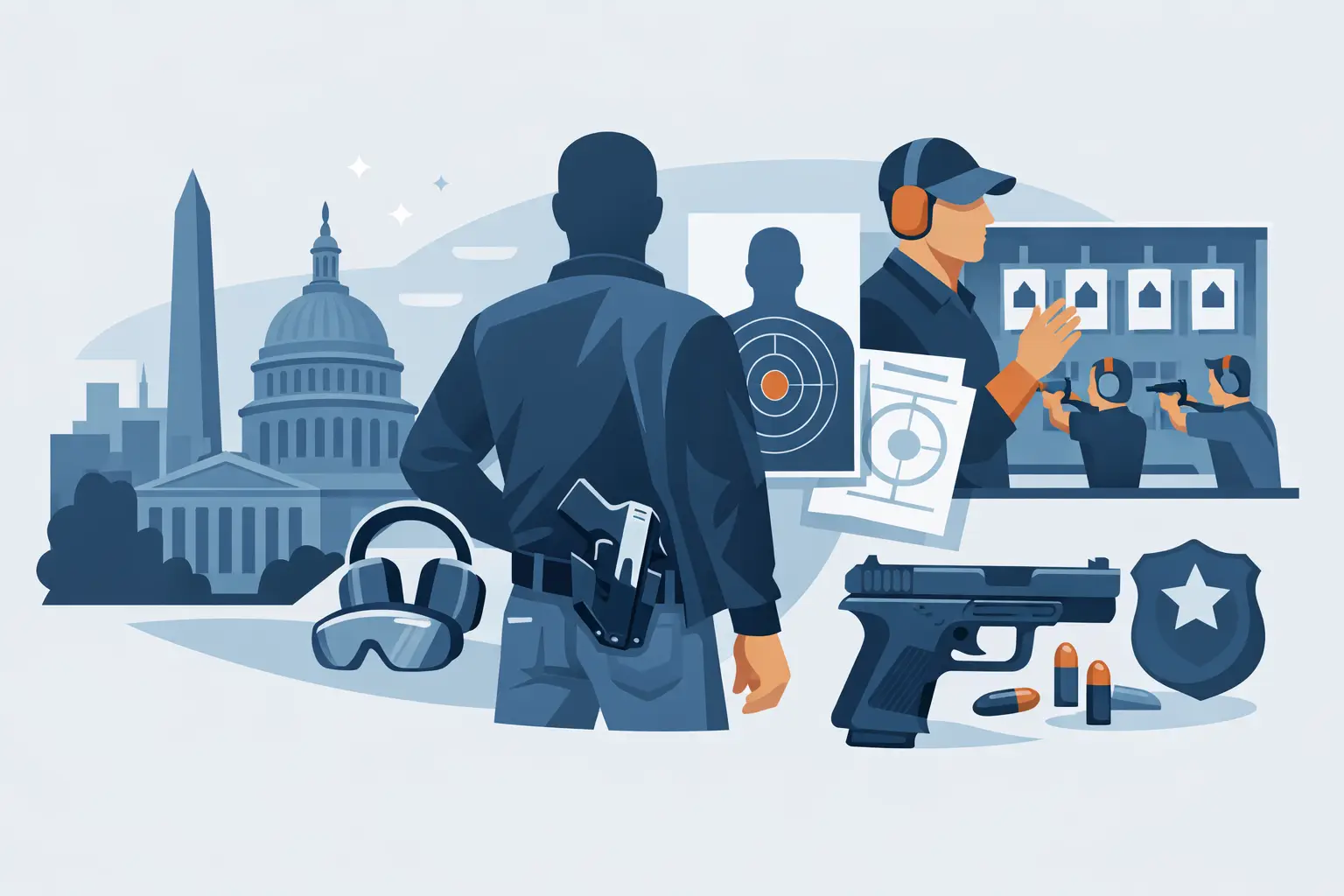
A DC concealed carry permit class is not simply a day at the range. For a responsible applicant, it is the required training process that connects safe handgun handling, District-specific law, qualification standards, and a complete permit application. If your goal is to carry lawfully in Washington, DC, treat the course as a compliance requirement with real operational consequences.
The District has its own application process, restrictions, and training expectations. Training completed for Virginia, Maryland, Utah, or another jurisdiction may be valuable, but it does not automatically satisfy every District requirement. Applicants should confirm current Metropolitan Police Department requirements before registering, submitting paperwork, or relying on prior credentials.
What a DC Concealed Carry Permit Class Is Designed to Do
District concealed handgun training is intended to establish that an applicant can handle a firearm safely, understand applicable laws, and meet the required live-fire qualification standard. A quality class does more than present slides and administer a shooting test. It puts the student in a position to make informed, lawful decisions before carrying a handgun in public.
For students coming from private security, executive protection, or law enforcement backgrounds, the fundamentals may feel familiar. That does not eliminate the need to understand the District’s rules. Professional experience, a Virginia DCJS credential, or a Maryland Wear & Carry qualification can support your overall competence, but each jurisdiction controls its own permit process.
The course should address both technical and legal readiness. You are expected to handle and store the handgun safely, demonstrate control on the range, and understand when a firearm may and may not be carried or used. The permit is not authority to ignore prohibited locations, property rules, or the duty to act with restraint and sound judgment.
Training Topics Applicants Should Expect
A compliant course generally includes classroom instruction and live-fire range training. The required course length and qualification details can change through District policy or law, so always verify the current standard before enrolling. Training providers should clearly state what their program includes, what documentation students receive, and what students must bring.
Firearm Safety and Handling
Students should expect direct instruction on the core safety rules: keeping the firearm pointed in a safe direction, keeping a finger off the trigger until ready to fire, keeping the gun unloaded until use is intended, and knowing the target and what is beyond it. These rules are simple, but applying them consistently under pressure is the standard.
Instruction should also cover loading and unloading procedures, safe holstering, clearing common malfunctions, secure storage, transportation, and safe transfer of a firearm. A permit class is not the place to rely on guesswork about your particular handgun. Bring equipment you can operate safely, or arrange training equipment through the provider when available.
District Law and Carry Responsibilities
The legal portion should focus on the responsibilities that come with carrying a concealed handgun in the District. Students need to understand the difference between possessing, transporting, displaying, and using a firearm. They also need practical awareness of prohibited places, interactions with law enforcement, requirements that may apply during a traffic stop or official encounter, and the consequences of carrying where it is not authorized.
Use-of-force instruction deserves particular attention. Carrying a handgun does not make every conflict a firearms problem. A responsible permit holder understands avoidance, verbal de-escalation, escape options, and the serious legal and personal consequences of deadly force. The correct decision is often to create distance, call law enforcement, and avoid a confrontation entirely.
This portion of the class should not be treated as casual legal advice. Laws, court decisions, agency policies, and restricted-location rules can change. Students should retain their course materials and continue checking official District guidance after completing training.
Range Qualification and Practical Skills
Live-fire qualification evaluates whether the student can safely operate a handgun and place accurate shots under the prescribed course of fire. It is not a competition and it is not advanced tactical training. The objective is safe, controlled performance that meets the District standard.
Students commonly need a reliable handgun, appropriate ammunition, eye and ear protection, a sturdy belt and holster if required by the range protocol, and government-issued identification. Exact equipment requirements vary by provider and range. Ask before class rather than arriving with prohibited ammunition, an unsuitable holster, or insufficient magazines.
A student who has not fired recently should consider taking a basic handgun or refresher course before the permit class. The time to correct grip, stance, sight alignment, trigger control, and loading errors is before qualification day. A class can teach and coach, but applicants remain responsible for demonstrating safe handling.
Before You Register for the Class
Start with the permit application requirements, not just the course calendar. Determine whether you meet the District’s eligibility conditions and identify the documents you will need. Depending on current requirements, that may involve identification, proof of residency or other supporting records, photographs, fingerprints, a firearms-training certificate, and application forms.
Do not assume that an old certificate will be accepted. Training documentation can have validity periods, and certificates must accurately identify the course and instructor. If you have prior military, law-enforcement, or firearms-instructor training, verify whether it qualifies for any training consideration before relying on it. Bring the actual records, not an assumption that your prior position will speak for itself.
Review the provider’s prerequisites as well. Some classes are structured for experienced shooters who are ready to qualify, while others provide more foundational instruction. The least expensive class is not always the right choice if you need help building safe gun-handling skills first. Conversely, a student with current, documented proficiency may not need extensive remedial training.
How to Prepare for a Productive Training Day
Arrive early with your required identification, training materials, range equipment, and payment for any range or qualification fees not included in tuition. Wear closed-toe shoes and practical clothing appropriate for range movement. Avoid clothing that makes holstering unsafe or allows hot brass to fall into an exposed area.
Plan to be mentally present. Do not arrive fatigued, impaired, distracted by work calls, or rushed from another commitment. Firearms training requires attention to instructor commands and range safety procedures. If an instructor calls a cease-fire, stops a drill, or corrects your handling, respond immediately and professionally.
Students should also be ready to ask specific questions. For example: What documentation will I receive after successful completion? Does the class include the required range qualification? What happens if I do not qualify on the first attempt? Are retest fees, ammunition, firearm rental, or range fees separate? When does the certificate get issued? Clear answers prevent application delays later.
Training Is Only One Part of the Permit Process
Completing a DC concealed carry permit class does not mean a permit has been issued. Training is one component of a larger application process administered by the District. The applicant remains responsible for submitting accurate forms, completing any required fingerprinting or background-review steps, paying applicable government fees, and responding promptly if additional information is requested.
Keep copies of every document submitted. Store your training certificate, qualification record, application confirmation, receipts, and correspondence in one secure file. This is a practical habit for any credentialed professional. It helps if an agency requests clarification, if you need to track renewal timing, or if you later pursue additional credentials.
Permit holders also need to stay current after approval. Renewal requirements, training intervals, carrying restrictions, and administrative procedures may differ from the initial application. Carrying under an expired permit or relying on outdated rules can create serious legal exposure.
Choose Instruction That Treats the Requirement Seriously
Look for a program that identifies the jurisdiction, explains the current training scope, uses qualified instructors, and provides structured range supervision. A rushed certificate-only approach can leave students with unanswered questions about safety, lawful carry, and the application packet. That is not the standard a responsible armed citizen or protective-services professional should accept.
A Security Training Academy, Inc. approaches firearms and protective-services training with the same discipline expected in regulated security work: verify the requirement, complete the correct course, retain the record, and maintain the skill. Before you carry, make sure your training, paperwork, equipment, and judgment are all ready for the responsibility.
 Install Security Training Academy