

Last Updated: October 25, 2026
Quick Summary
To get a DCJS security license, you must be at least 18, complete approved entry-level training, pass a criminal history background check with electronic fingerprints, and submit a complete application with the fee to DCJS. The state issues this individual registration to you, not your employer or training school. Armed registration requires approved firearms training and range qualification on top of the unarmed requirements.
- A business license is separate from the individual registration you need to work as a security officer.
- Training from a non-approved provider won’t count toward your registration.
- A concealed handgun permit does not substitute for the approved armed security firearms course.
- Confirm your fingerprints reached DCJS before applying, or your application sits in a pending queue.
- Complete approved in-service training and submit your renewal application before your expiration date.
Table of Contents
- What a DCJS Security License Is and Who Needs One
- Virginia DCJS Security Officer Registration Requirements
- Virginia DCJS Unarmed Security Guard Training
- Virginia DCJS Armed Security Officer Requirements
- Submitting Your Application and Checking Registration Status
- Virginia DCJS Security Registration Renewal
- Register for DCJS-Compliant Training
- Frequently Asked Questions
What a DCJS Security License Is and Who Needs One
A DCJS security license is the credential Virginia requires before you can work as a security officer, and it comes from the Department of Criminal Justice Services.
This guide from A Security Training Academy, Inc walks you through every step, from picking the right registration category to holding your credential in hand.
Here’s what most people get wrong early: they assume the license comes from their employer or their training school. It doesn’t. The state issues it to you, as an individual. Your school only prepares you for it.
Individual Registration vs. Business License
These get confused constantly, so let’s separate them.
Individual registration is what you need. It’s your personal credential to work as a security officer. You apply, you get fingerprinted, you carry the card.
A business license is what a security company needs to operate. That’s a separate application filed by the company, not by you.
If you’re an employee or a new officer, you need the individual registration. Full stop.
Virginia DCJS Security Officer Registration Requirements
The core requirements are straightforward: you must be at least 18, complete approved entry-level training, pass a criminal history background check, and submit a complete application to DCJS. Miss any one of these and the application stalls.
Here’s the checklist we walk every student through:
- Minimum age of 18
- Completed approved entry-level training course
- Electronic fingerprints submitted for the background check
- Completed application with supporting documents
- Payment of the application fee
The Virginia DCJS official website is the final word on current forms and fees. Check it before you submit anything. Rules change, and outdated advice circulates widely.
Eligibility and Disqualifying Conditions
Not everyone qualifies, and it’s better to know now than after paying for training.
Common disqualifiers include certain criminal convictions, pending charges, and providing false information on the application. DCJS reviews criminal history case by case, so a past issue doesn’t always mean automatic denial.
Our advice: be honest on every form. Hiding something that shows up in the background check is the fastest way to a denial.
Virginia DCJS Unarmed Security Guard Training
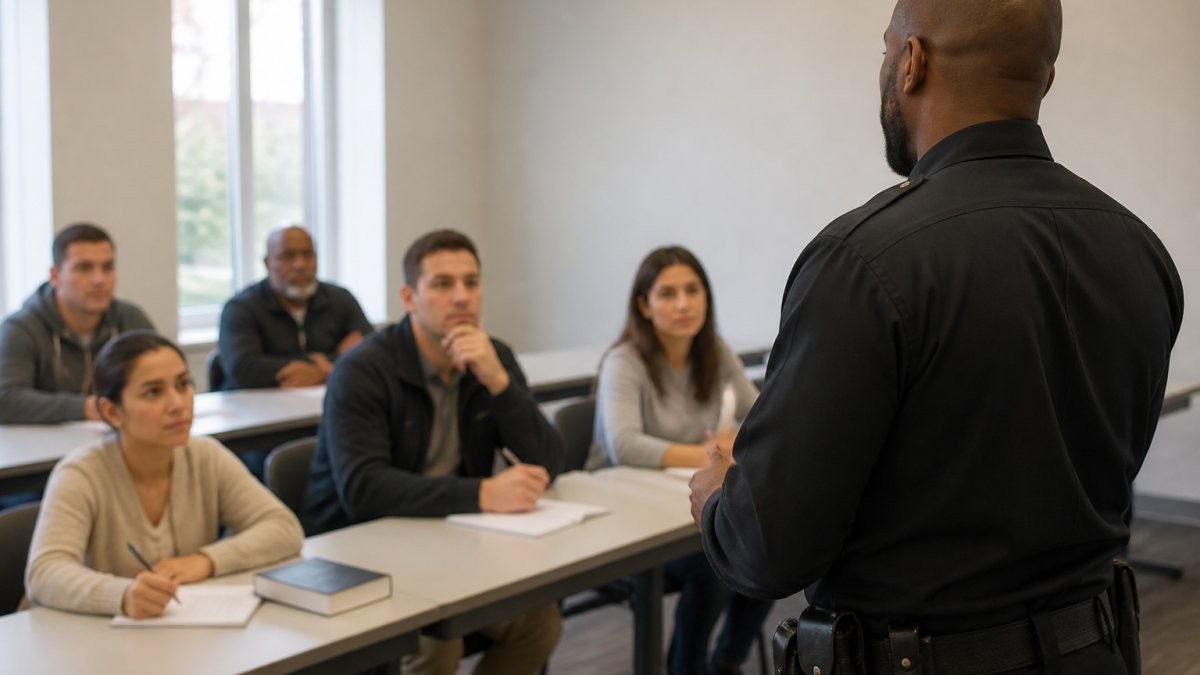
Unarmed training is the entry point for most new officers. It covers the core subjects DCJS requires: legal powers and limitations, security procedures, emergency response, and report writing.

Course length and content are set by state regulation, so confirm current hours with your training provider.
Pick your course carefully. Not all training is approved, and training from a non-approved provider won’t count toward registration.
Virginia DCJS Armed Security Officer Requirements
Armed registration is a separate credential from unarmed registration, and it carries more scrutiny. You must meet all unarmed requirements first, then add approved firearms training, range qualification, and additional documentation. The armed path is not a shortcut, it’s a stacked sequence.
Here’s the ordered pathway:
- Complete unarmed entry-level training. You cannot skip straight to armed. The unarmed course covers legal powers, security procedures, and report writing, foundational material the armed course builds on.
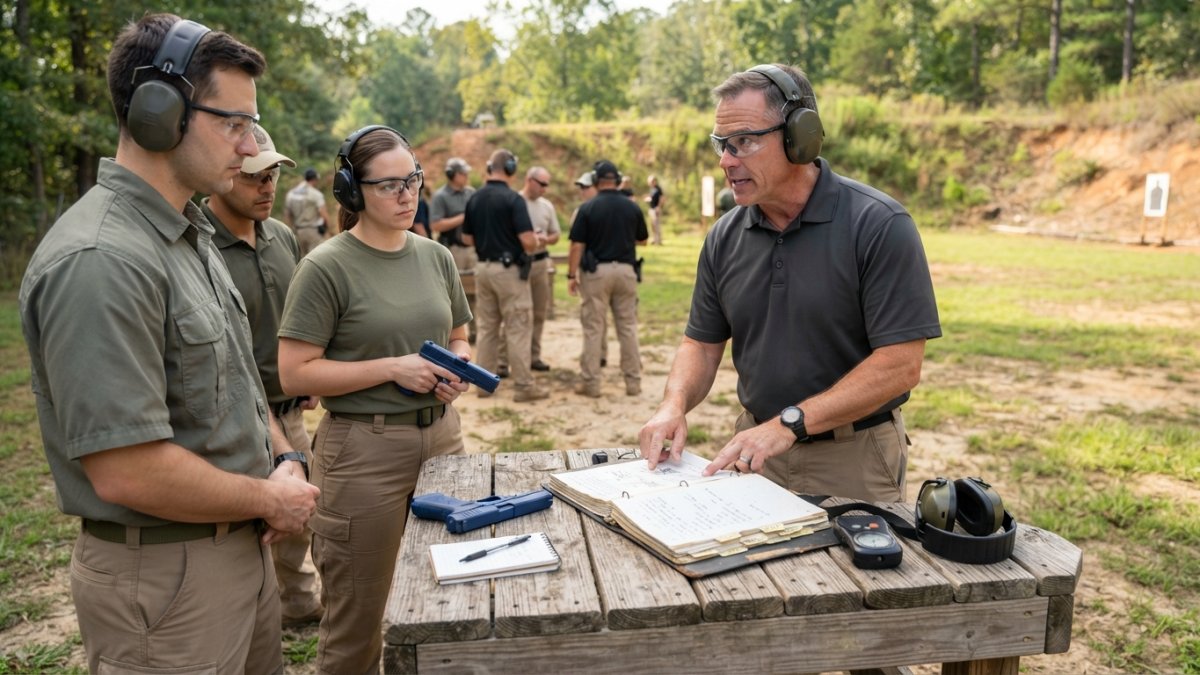
- Complete approved firearms training. This is a separate course taught by a DCJS-approved firearms instructor. It covers firearm safety, marksmanship, use-of-force law, and judgment. Confirm the course is approved for armed security registration, not just general concealed carry.
- Qualify on the range. You must demonstrate proficiency with the firearm you’ll carry. Qualification standards are set by state regulation. If you fail to qualify, you may need remedial training before retesting.
- Submit fingerprints and background check. The same criminal history check applies, with the same case-by-case review.
- Apply under the armed category. Your application must reflect the armed category and include your firearms training certificate and qualification record.
- Pay the armed application fee. Fees are higher than unarmed and are listed on the DCJS website.
Don’t assume your concealed handgun permit substitutes for armed security training. It doesn’t. The armed security credential requires the approved security firearms course and range qualification, which are separate from a concealed carry permit.
Armed vs. Unarmed: Which Path Is Right for You?
If you’re new to security work, start unarmed. It’s the entry point for most officers, and many employers require a period of unarmed experience before assigning armed posts. If you’re already unarmed-registered and your employer wants you armed, tell your training provider up front, the course sequence and paperwork differ, and switching midstream wastes time and money.
Cost and Timeline Considerations
Armed registration costs more than unarmed because of the additional firearms course, range time, and higher application fee. Training providers set their own course prices, so compare approved providers.
If you plan to work armed, confirm with your employer which firearm you’ll be required to carry and qualify with. Some posts require specific calibers or models, and qualifying with the wrong firearm can mean repeating the range portion.
The armed credential follows a fixed sequence, and each step depends on the one before it.
| Step | What to do | Note |
|---|---|---|
| 1 | Complete unarmed entry-level training | Cannot skip straight to armed |
| 2 | Complete approved firearms training | Taught by DCJS-approved firearms instructor |
| 3 | Qualify on the range | Standards set by state regulation |
| 4 | Submit fingerprints and background check | Same case-by-case criminal history review |
| 5 | Apply under the armed category | Include firearms certificate and qualification record |
| 6 | Pay the armed application fee | Higher than unarmed; listed on DCJS website |
Submitting Your Application and Checking Registration Status
Once your training certificate is in hand and your fingerprints have been transmitted, you’re ready to submit your application through the DCJS online system. This is where many first-time applicants stall, not because they lack qualifications, but because they miss a field, upload the wrong document, or assume their fingerprints reached the state when they didn’t.
Here’s the ordered walkthrough we give every student:
- Confirm fingerprint transmission. Your electronic fingerprints are taken at an approved vendor and sent to DCJS and the FBI. Ask the vendor for the transaction confirmation number and keep it. If you apply before the prints are received, your application will sit in a pending queue.
- Log in to the DCJS online application system. Create an account if you haven’t already. Use the same legal name that appears on your training certificate and government ID, mismatches are a leading cause of delays.
- Select the correct registration category. Unarmed, armed, courier, and other categories have different training and documentation requirements. Choosing the wrong category means your application will be returned.
- Upload supporting documents. You’ll need your training completion certificate, proof of fingerprint submission, and any category-specific records. Scan at a readable resolution and save as PDF where accepted.
- Pay the application fee. Fees vary by category and are listed on the DCJS website. Keep the receipt.
- Submit and save your confirmation. The system issues a confirmation number. Store it with your other records.
Before you hit submit, review every field against your source documents. A common pattern is a transposed digit in a Social Security number or a misspelled middle name, both trigger manual review and add days to processing.
Checking Your Application Status
After submission, you can track your application through the DCJS online portal. Statuses typically move from received to under review to approved or pending additional information. Processing takes business days, not hours, so plan for a wait.
If your status shows pending additional information, check your email, including spam and promotions folders, for a notice from DCJS. Respond promptly with the requested documents. If your status hasn’t moved after a reasonable wait, call the DCJS licensing division and have your confirmation number ready.
Common Submission Errors and Fixes
- Fingerprints not received: Recheck with your fingerprint vendor. If the transmission failed, you may need to be reprinted.
- Wrong training certificate: Confirm the course you completed is approved for the category you’re applying under. Training from a non-approved provider won’t count.
- Name mismatch: Use your full legal name exactly as it appears on your ID. If you’ve recently changed your name, include documentation.
- Missing fee payment: The application won’t process until payment clears.
What to Do If Your Background Check Is Delayed
Background checks can take longer if a record requires manual review or if a disposition is missing. DCJS reviews criminal history case by case. If your application is delayed for this reason, you may be asked to provide court documents or a written explanation.
Our how to apply for DCJS registration in Virginia walkthrough covers the form fields step by step. Prefer to watch it done? Our registration video guide shows the process on screen so you can follow along and avoid common mistakes.
Virginia DCJS Security Registration Renewal
Registration doesn’t last forever. You renew on the state’s schedule and complete the required in-service training before your renewal application goes in. Let it lapse and you can’t legally work until it’s restored.
Renewal basics:
- Complete approved in-service training
- Submit the renewal application before your expiration date
- Include all required records and fees
- Confirm your new credential once approved
The DCJS training and renewal standards list the current in-service requirements. Our guide on how to renew security registration in Virginia breaks down the training choices and timing so nothing slips.
Don’t wait until the last month. In-service courses fill up, and a missed deadline means time off work.
Register for DCJS-Compliant Training
The path to a DCJS security license is short when you follow it in order: confirm you qualify, complete approved training, submit a clean application, and renew on time. Every step depends on the one before it.
That’s where we come in. A Security Training Academy, Inc provides DCJS-compliant security training, firearms certification, and guidance through the registration and renewal paperwork.
Ready to start? Register for DCJS security officer training and get your course path mapped out. For the full requirements breakdown, read our DCJS registration requirements guide.
Frequently Asked Questions
How long does it take to get a DCJS security license?
The timeline depends on your registration category and how quickly you complete training. Unarmed entry-level courses take about 24 hours of instruction, while armed categories require additional firearms training. After you submit your application and supporting documents through the DCJS registration system, processing typically takes several business days. First-time applicants should plan for a few weeks from starting training to receiving the credential.
What training is required for a Virginia DCJS security registration?
Unarmed security officers must complete entry-level training covering security officer core subjects, including legal powers and limitations, emergency procedures, and report writing. Armed security officer requirements add firearms training and range qualification on top of the core curriculum. All courses must be taken through a DCJS-approved training provider, and you will receive a course certificate to submit with your application.
How much does a Virginia DCJS security license cost?
Costs include the application fee paid to DCJS and the tuition charged by your approved training provider. Training pricing depends on the category and provider, so confirm current rates directly with the academy before enrolling. Budget for both the state fee and course cost, and keep receipts for your records. Renewal also carries a fee, so plan for that recurring expense once your registration is active.
How do I check the status of a DCJS security registration?
Use the DCJS registration system to look up your application status after submitting. Have your application reference number and personal details ready. If your status shows pending for longer than the stated processing window, contact DCJS directly to confirm whether any supporting documents are missing. Keep copies of everything you submit so you can resolve questions quickly and avoid delays in receiving your credential.
Getting registered shouldn’t feel like guesswork. A Security Training Academy, Inc handles the training and the paperwork guidance so you can focus on your first post. Get started with A Security Training Academy, Inc and begin your DCJS-compliant training this month.





 Install Security Training Academy