

Last Updated: November 22, 2026
Quick Summary
Firearms instructor certification requires legal ability to possess a firearm, a documented prerequisite training certificate, and a passing score on a scored skills assessment. Most programs also require a minimum age, a clean record, an application with fees, and completion of an instructor development course and written exam.
- Complete the prerequisite basic training course before enrolling in any instructor-level class.
- Online coursework can prepare you for the written exam but cannot replace the live range skills assessment.
- The pistol qualification is pass/fail, scored on hits inside a scoring ring, not group size or speed.
- Practice the exact course of fire, target, and time limits at least three times before test day.
- Confirm whether your state requires a state-issued instructor credential or accepts a private organization’s certificate.
Table of Contents
- What Firearms Instructor Certification Actually Requires
- Core Eligibility and Minimum Qualifications
- Legal Ability to Possess Firearms
- Step-by-Step: From Applicant to Certified Instructor
- NRA Instructor Certification Online: What You Can and Cannot Do
- NRA Firearms Instructor Course Cost: What Drives the Price
- The NRA Pistol Instructor Qualification Course of Fire
- Firearms Instructor Jobs: Where Certified Instructors Work
- State-by-State Requirements and Credential Differences
- Renewal, Insurance, and Staying Current
- Frequently Asked Questions
What Firearms Instructor Certification Actually Requires
Firearms instructor certification requirements start with one non-negotiable: you must be legally able to possess a firearm, and you must be able to prove it on paper.
That distinction matters.
Below, we’ll show you exactly what each stage demands, where applicants most often get rejected, and how state rules change the picture entirely.
Firearms instructor certification is a credential issued by a training organization or state authority that confirms an individual has met minimum marksmanship and instructional standards to teach others safely.
Core Eligibility and Minimum Qualifications
The most common mistake applicants make is assuming shooting skill alone qualifies them. It doesn’t.
Programs generally screen for a minimum age, lawful firearm possession, and a documented training prerequisite. Many require completion of a basic instructor course before the discipline-specific one.
Watch out: candidates who skip the prerequisite course and enroll directly in an instructor-level class usually lose their deposit and their seat. Confirm the sequence before you pay.
Legal Ability to Possess Firearms
Legal eligibility is checked first and disqualifies fastest. Federal law bars certain categories of people from possessing firearms, and the federal statutes on unlawful possession set those categories out clearly.
A certification program will ask you to attest to your legal status and may require supporting documentation. Expunged records, pending charges, and state-level prohibitions can all complicate an otherwise clean application. If there is any ambiguity in your record, resolve it with the issuing authority before you enroll, not after.
Step-by-Step: From Applicant to Certified Instructor
Here is the sequence most programs follow, and the order matters:
- Complete the prerequisite basic training course
- Confirm legal eligibility and gather supporting documentation
- Submit the application form with fees
- Attend the instructor development course
- Pass the written examination
- Pass the handgun skills assessment
- Receive your certification and register where required

Application, Forms, and Supporting Documentation
Documentation is where applications stall. Expect to provide proof of the prerequisite course, identification, and any records the program requests. Some jurisdictions require a memorandum of understanding between the training provider and the certifying body.
Keep copies of everything. A common mistake is submitting originals and having nothing to reference when a question comes back weeks later.
Skills Assessments and Qualification Scores
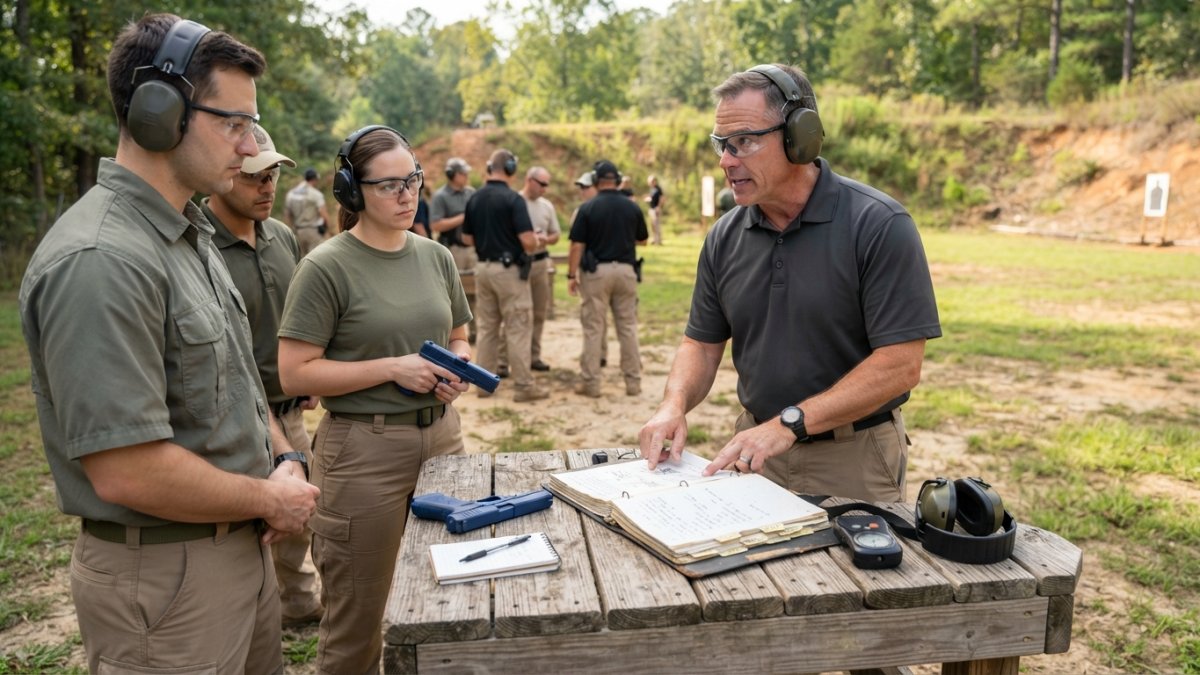
The skills evaluation is a scored course of fire, not a casual range session. Candidates shoot a set number of rounds at specified distances under time pressure, and the qualification score must meet the program’s threshold to pass.
Preparation matters more than raw talent here. Our guidance on how to prepare for your range qualification covers the paperwork, equipment, and practice routine that keep candidates from failing on technicalities.
NRA Instructor Certification Online: What You Can and Cannot Do
Online coursework can cover the classroom portion. It cannot certify you as a firearms instructor on its own.
The reason is practical: a skills assessment requires a live range, a certified evaluator, and a scored course of fire. No online module replaces that.
If a program promises full firearms instructor certification with no in-person evaluation, treat that as a red flag. Verify the credential’s recognition before you pay for it.
NRA Firearms Instructor Course Cost: What Drives the Price
Pricing depends on the discipline, the course length, and what the fee includes. Instructor-level courses cost more than basic training because they run longer and require range time with an evaluator.
The variables that move the number:
- Number of disciplines you certify in
- Whether materials and printed manuals are included
- Range fees and ammunition
- Renewal or registration fees charged separately
We don’t publish fixed figures here because fees change and vary by location. Our course fees page lists current pricing so you can budget accurately before enrolling.
The NRA Pistol Instructor Qualification Course of Fire
The pistol qualification is a defined course of fire: a set round count, fixed distances, and time limits, scored for accuracy.
What most guides leave out is how the scoring actually works, because that is where candidates fail.
Three mechanics decide most outcomes:
- The scoring ring, not the bullseye. Hits outside the scoring ring count as misses even if they land on paper. Practicing on a plain bullseye teaches the wrong sight picture.
- The reload and the transition. Many candidates shoot clean strings and then lose points on the string that requires a magazine change or a draw from the holster under a time limit. Practice the string, not just the shot.
- The pass/fail line. There is no partial credit. A candidate one hit short of the threshold repeats the entire qualification, and some programs charge a re-test fee or require a remedial block before the retake.
Watch out: practicing general marksmanship at your own pace builds confidence but not the specific skill the evaluator scores.
For a concrete example of how handgun qualification standards work in practice, review the Maryland armed security handgun qualification requirements, which show the range performance and record-keeping expected of armed professionals.
Firearms Instructor Jobs: Where Certified Instructors Work
Certified instructors find work in several settings: private training academies, security firms that train their own staff, recreational ranges, and independent contract teaching. Many instructors combine certification with a security career, using it to qualify and renew armed personnel.
The Bureau of Labor Statistics outlook for related protective service roles is worth reviewing if you’re weighing this as a career step rather than a side credential. Our firearms training for private security careers page shows how the two fit together.
State-by-State Requirements and Credential Differences
This is where most guides stop short. Certification is not uniform, and the differences decide where you can teach. The table below shows the variation categories, and the sections after it explain the credential types and how to verify the rules that apply to you.
| Requirement Area | Typical Variation Across States |
|---|---|
| Issuing authority | State agency, private organization, or both |
| Minimum age | Varies by state statute |
| Prerequisite training | Basic course, security license, or none specified |
| Qualification score | Round count and distance thresholds differ |
| Renewal period | Annual to multi-year cycles |
| Reciprocity | Limited or none between states |
Three credentials that share a name but not the authority
A private organization’s instructor certificate, a state-issued instructor credential, and an agency instructor qualification are three different things, and conflating them is the most expensive mistake in this field.
- Private training-organization certification. Issued by a national or regional training body after its own instructor development course and skills assessment. It authorizes you to teach that organization’s curriculum and issue its certificates. It does not, by itself, satisfy a state licensing requirement for armed security instructors.
- State-issued instructor credential. Issued by a state regulatory agency, often the same agency that licenses armed security officers. It authorizes you to teach the state-mandated curriculum and sign off on qualification records that the state accepts. It is usually tied to a specific state and does not transfer.
- Agency instructor qualification. Issued by a law enforcement agency or a security employer for its own personnel. It authorizes instruction inside that agency only and typically expires when employment ends.
A credential can be valid and still be useless for your goal. Before you pay for any course, confirm which of the three your employer, your students, or your state regulator will actually recognize.
How to verify the rules that apply to you
Requirements change, and a guide, including this one, is a starting point, not the authority. Verify in this order:
- Identify the state agency that regulates armed security or private training in your state, and read its current instructor requirements page.
- Confirm whether the agency requires a state-issued instructor credential or accepts a private organization’s certificate.
- Check the renewal cycle and the continuing-education hours in the current statute or regulation, not a summary.
- Confirm reciprocity in writing before you plan to teach across a state line.
Watch out: a training provider’s marketing page is not the rule. If the provider’s description and the state agency’s page disagree, the agency’s page governs, and you should get the discrepancy resolved in writing before you enroll.
Two credentials with similar names can carry very different authority. A private organization’s instructor certificate is not the same as a state-issued one, and neither automatically transfers across state lines. Check which credential your employer or students will actually recognize.
Renewal, Insurance, and Staying Current
Certification expires. Renewal usually requires proof of continuing education, a current qualification score, and a fee.
Insurance deserves equal attention. Instructors carry liability exposure every time they run a line, and coverage requirements vary by program and employer.
Rules change, and outdated training is wasted money. Our breakdown of security renewal requirements in VA, DC, and MD tracks the timelines and documents that keep a credential active.
Certification rewards preparation, not enthusiasm.
Frequently Asked Questions
What does it take to be a certified firearms instructor?
You need to meet the eligibility requirements of the credential you pursue, which typically include a minimum age of 21, legal ability to possess firearms, and documented firearm proficiency. Most programs also require a prerequisite safety course, an instructor development course, and a passing qualification score. State-issued credentials add an application, background check, and supporting documentation. Requirements vary by state and by credential type, so verify the current standards with the issuing body before enrolling.
How much does NRA firearms instructor course cost?
NRA firearms instructor course cost depends on the discipline, the training provider, and whether you take prerequisite courses first. Fees usually cover instruction, materials, and range time, and some providers charge separately for ammunition and certification processing. Because prices change and vary by provider, ask for a current quote rather than relying on older figures. Budget for the prerequisite course, the instructor course itself, and any state application fees as separate line items.
How long is NRA instructor certification good for?
NRA instructor credentials are generally valid for a set certification period, after which you complete renewal requirements to keep teaching. Renewal usually involves an updated application, confirmation that you still meet eligibility requirements, and sometimes a refresher or continuing education component. Because renewal rules can change, check the current certification standards with the issuing organization before your expiration date. Keep copies of your course completion records and qualification scores on file.
Do you need prior firearms experience to become an instructor?
Yes. Instructor programs expect demonstrated firearm proficiency before you teach others. That usually means completing a prerequisite course in the discipline you plan to teach and passing a skills assessment with a qualifying score. Law enforcement, military, or private security experience can help document proficiency, but it does not automatically replace the required course or qualification. If you are new to firearms, build your skills through foundational training first, then apply for instructor development.
Can a security professional become a firearms instructor?
Security professionals can pursue instructor certification, and their range and duty experience often helps with the skills assessment. The process still requires the same eligibility checks, prerequisite courses, and qualification scores as any other candidate. In states with their own instructor licensing, you may need a state-issued credential in addition to a national certification. Confirm which credential your employer or students will recognize before you invest in training.
How do you renew a firearms instructor certification?
Renewal typically requires submitting an application before your certification period ends, confirming you still meet eligibility requirements, and completing any continuing education or refresher training the issuer requires. Some credentials also require a current qualification score or proof of active teaching. Keep your records organized and calendar the renewal window early, because lapses can mean retaking the initial course. Always verify renewal requirements with the issuing body, since standards change.



 Install Security Training Academy