

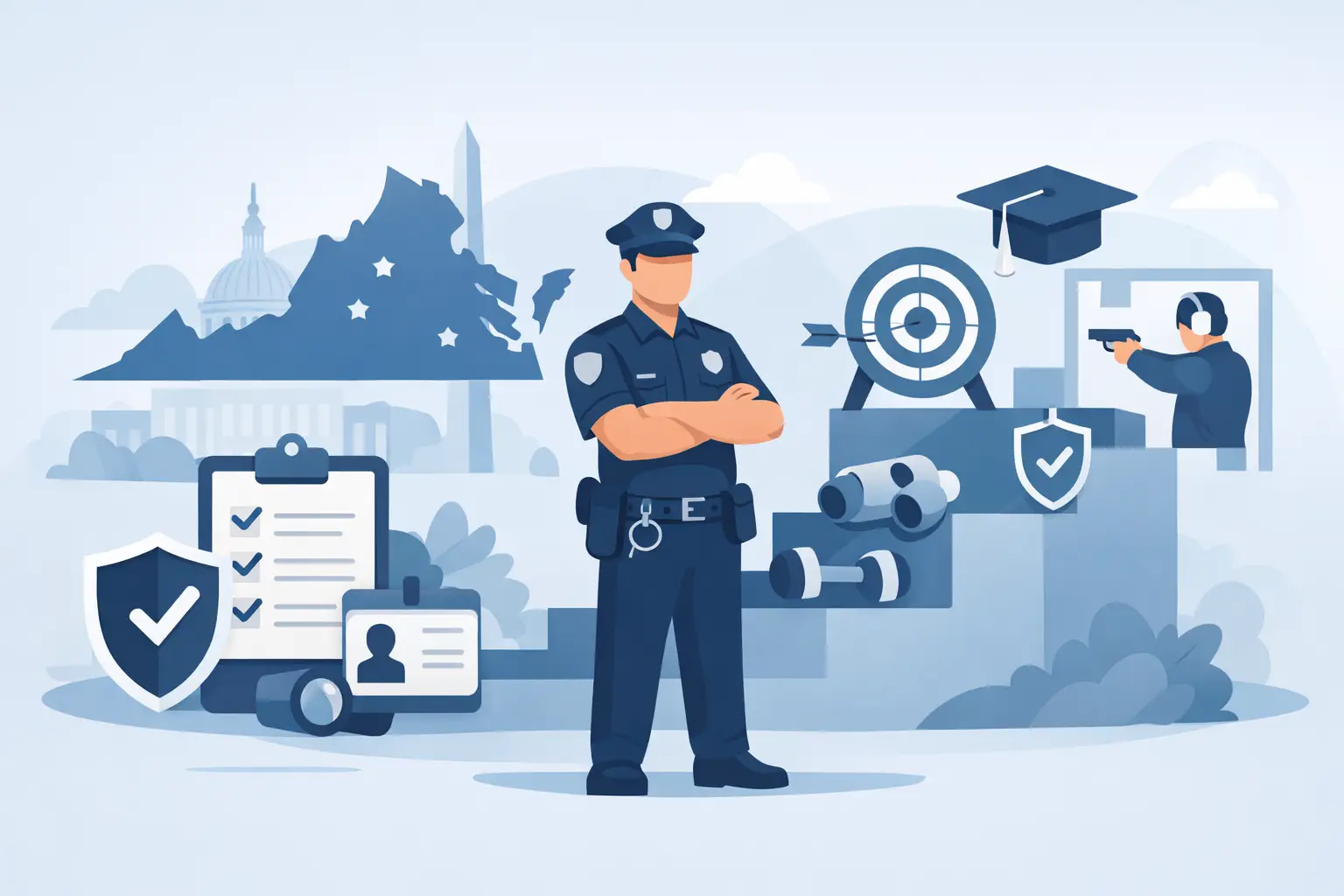
A Virginia security job can begin with a course registration, but it does not end there. Virginia DCJS security officer training is the required professional foundation for people who will protect property, control access, observe and report incidents, and represent a client at public-facing or sensitive locations. The training matters because private security officers operate under defined legal limits. A uniform, a post assignment, or prior experience does not replace the proper DCJS credential.
The correct path depends on the work you intend to perform. An unarmed officer assigned to a commercial building has a different training and registration route than an armed officer, a personal protection specialist, or a professional seeking a specialized credential. Start with the job function, then select the DCJS course and application process that match it.
Start With the Correct Virginia DCJS Training Path
For most new applicants, the first question is whether the position is unarmed or armed. Virginia recognizes separate entry-level training categories for these roles. Unarmed security officer training addresses the core responsibilities of private security work. Armed security officer training carries additional prerequisites, classroom instruction, firearms handling requirements, qualification standards, and continuing obligations.
Do not register for an armed course simply because it appears to offer more job options. Armed work brings greater responsibility, higher employer expectations, and a higher standard of judgment. It may require applicants to meet eligibility requirements that do not apply to unarmed registration. A person who is not prepared to qualify, safely carry a firearm, and make disciplined use-of-force decisions may be better served by beginning in an unarmed assignment.
Virginia DCJS course codes help identify the proper program. New officers commonly encounter entry-level designations such as 01E for Security Officer Core Subjects and 07E for Armed Security Officer entry-level training. In-service designations apply to active registrants renewing their credentials. Course hours, prerequisites, and procedural requirements can change, so students should confirm the current DCJS requirements before paying for a class or submitting an application.
Unarmed Security Officer Entry-Level Training
Unarmed entry-level instruction prepares officers for the realities of a post assignment. The work is not simply standing at a door or watching cameras. Officers must understand access control, patrol procedures, incident reporting, emergency response, customer interaction, professionalism, and the limits of their authority.
A well-prepared officer can identify a policy violation, preserve the facts, notify the appropriate person, and write a report that a supervisor or client can rely on. That ability improves employability. It also protects the officer when an incident is later reviewed by management, law enforcement, an attorney, or a regulatory agency.
Students should expect training to address subjects such as legal authority, ethics, observation, communication, report writing, and emergency procedures. Reality-based instruction is valuable because a security officer often has to make calm decisions in imperfect conditions: a tenant refuses to leave, an alarm activates at shift change, a visitor challenges access procedures, or a supervisor needs clear information immediately.
Armed Security Officer Training Requires More Preparation
Armed officer training is not a shortcut to carrying a firearm at work. The course is designed for a role where the officer may be assigned an approved firearm by a properly licensed employer and must demonstrate safe handling, judgment, and qualification proficiency.
Applicants should review all eligibility requirements before enrolling. Training completion, firearms qualification, fingerprinting, and a DCJS registration application are separate parts of the process. Completing a class does not by itself authorize someone to work armed. Likewise, a concealed-carry permit is not the same as a Virginia armed security officer registration and does not substitute for the training required for an armed post.
Students should arrive prepared to follow range safety commands, maintain equipment responsibly, and accept correction. Firearms training should cover more than hitting a target. Professional armed work requires sound decisions about safe firearm handling, retention, use-of-force considerations, de-escalation, report writing, and post-incident responsibilities.
Training Is Only One Part of DCJS Registration
A common mistake is treating the training certificate as the final credential. It is not. The certificate documents that required training was completed. DCJS registration is the state-issued authorization process that determines whether an individual may perform a regulated private-security function.
Applicants should plan for the full sequence: select the correct course, complete required training, obtain fingerprints through the approved process, submit the appropriate DCJS application and fees, and retain copies of all records. Processing times can vary. An employer may have its own hiring and onboarding requirements as well, including background screening, drug testing, uniforms, scheduling, and post-specific instruction.
Before class, gather the information that will be needed for your training record and application. This usually includes your legal name, current contact information, identification, and any existing DCJS registration number. Current registrants should bring their DCJS 99 number when requested so the course completion can be reported accurately.
Keep your course certificate, range qualification documentation when applicable, and registration records in a secure file. These documents can be needed for renewals, employer verification, audit questions, or a move into another regulated role. Administrative discipline is part of professional security work.
Choose Training That Matches the Job You Want
The best course is not always the fastest one on the calendar. Select training based on the role you are pursuing and the jurisdiction where you will work. Virginia, Washington, DC, and Maryland each have distinct licensing and training rules. A Virginia DCJS credential does not automatically provide authority to work as a DC Special Police Officer or to meet Maryland Wear and Carry requirements.
This matters in the DMV region, where an employer may operate across state lines and a candidate may see job postings that reference multiple credentials. Read the position description closely. Ask whether the assignment is unarmed or armed, whether the employer requires an active registration before hire, whether additional training is provided, and which jurisdiction governs the post.
A Security Training Academy, Inc. supports students who need to identify the appropriate Virginia DCJS pathway while also planning for career growth in the region. A broader course catalog can be useful when a security officer later moves toward personal protection, investigations, defensive equipment instruction, or another specialized role. Still, the first priority is completing the credential required for the job in front of you.
Maintain Your Credential Before It Becomes an Emergency
Security registration is not a one-time task. Virginia DCJS registrants must meet renewal requirements, including applicable in-service training, within the required cycle. Armed personnel may have additional firearms requalification and documentation responsibilities. Missing a deadline can affect your ability to remain assigned, accept shifts, or meet an employer’s compliance requirements.
Do not wait until the final week before expiration. Review your registration expiration date early, confirm the course designation required for your renewal, and schedule training far enough ahead to address any paperwork issue. Renewal is also an opportunity to sharpen skills that can become routine over time, particularly report writing, verbal communication, emergency response, defensive tactics, and firearms safety.
Use this practical pre-class check before you register:
- Confirm whether you need unarmed entry-level, armed entry-level, or in-service training.
- Verify the current DCJS prerequisites, application timing, and fingerprinting instructions.
- Bring the identification and DCJS registration information requested for the class.
- Plan separately for employer hiring requirements and any additional jurisdictional credential.
Professional Conduct Is Part of the Credential
DCJS training creates a baseline, but reputation is built on the post. Employers look for officers who arrive on time, maintain a professional appearance, follow post orders, communicate clearly, and document facts without exaggeration. Clients notice officers who are alert without being confrontational and helpful without stepping outside their authority.
The strongest security professionals understand that restraint is a skill. A good officer recognizes when a situation calls for observation, verbal direction, a supervisor, emergency services, or law enforcement. They do not create unnecessary conflict to prove authority. They preserve safety, follow policy, and document what occurred.
Treat your Virginia DCJS training as the first professional standard you meet, not a box to check. Build on it with reliable work habits, timely renewal, and specialized training that fits your assignment. That preparation gives employers a reason to trust you with greater responsibility when the right opportunity becomes available.
 Install Security Training Academy